Unlock the Infinite Banking System as a Non-US Resident
Infinite Banking is a powerful strategy that allows non-US residents to become their own banker and access the U.S. financial system.
For decades, the Infinite Banking Concept (IBC) has been one of the most powerful wealth-building strategies available. Popularized by Nelson Nash, the concept allows individuals to become their own banker, using properly structured whole life insurance policies to store capital, access liquidity, and finance their own investments.
Instead of relying on traditional banks to finance purchases or investments, individuals using the Infinite Banking Concept create their own private financing system. By storing capital inside specially structured life insurance policies, they gain the ability to borrow against their own capital while the underlying funds continue to grow.
This approach fundamentally changes how individuals interact with money. Instead of constantly paying interest to banks and financial institutions, Infinite Banking allows individuals to recapture the banking function in their own lives.
While the strategy is widely used in the United States, many people outside the U.S. believe it is impossible for non-US residents to participate. In reality, that assumption is incorrect.
With the right structure and documentation, non-US residents can legally access the Infinite Banking framework. The process simply requires a few additional preparatory steps to establish a financial presence within the United States.
This guide explains the first essential step in that process.
What Is the Infinite Banking Concept?
Before diving into the technical steps, it is important to understand what the Infinite Banking Concept actually is.
The Infinite Banking Concept was popularized by Nelson Nash, who explained how properly structured whole life insurance policies could be used as private banking systems.
Traditional banking works like this:
- You deposit money into a bank.
- The bank uses your deposits to lend money to others.
- The bank earns interest on those loans.
Infinite Banking simply flips that model.
Instead of storing your capital inside a bank, you store it inside a dividend-paying whole life insurance policy. These policies allow you to borrow against your policy value while your capital continues to grow.
In other words, you create your own personal financing system.
The core principles of Infinite Banking include:
- capital storage
- liquidity
- uninterrupted compound growth
- control over financing decisions
This strategy allows individuals to finance major purchases, investments, and opportunities without relying on traditional lenders.
Can Non-US Residents Use the Infinite Banking Concept?
One of the most common misconceptions surrounding Infinite Banking is that it is only available to U.S. citizens.
This belief usually comes from the fact that many insurance companies primarily operate inside the United States.
However, the concept itself is not restricted to citizens. The key requirement is the ability to interact with U.S. financial infrastructure.
This means establishing certain administrative connections within the United States.
These connections include:
- a U.S. mailing address
- a U.S. identification number (EIN)
- the ability to interact with American financial institutions
Once these basic elements are established, non-US residents can often access many of the same financial structures that Americans use.
The process simply requires a few additional administrative steps.
Step 1 – Establishing a U.S. Mailing Address
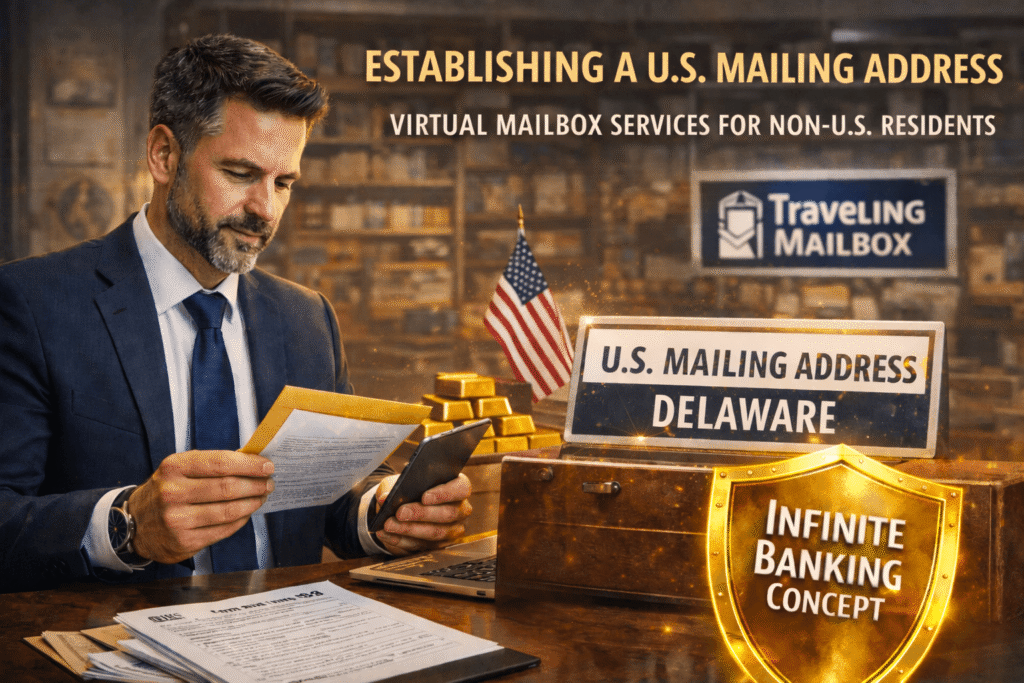
The first step for non-US residents who want to access the Infinite Banking system is establishing a U.S. mailing address through a professional mail service provider.
A physical mailing address in the United States is often required when interacting with U.S. financial institutions, insurance companies, and government agencies such as the IRS.
Many administrative processes in the United States require a domestic contact address.
This includes:
- EIN applications
- financial account openings
- communication with government agencies
- insurance policy documentation
For non-US residents, the easiest way to establish this presence is through a virtual mailbox provider.
Using a Virtual Mailbox Provider
A virtual mailbox provider gives international users a legitimate U.S. street address.
Unlike a traditional P.O. box, these services provide an actual physical address where mail can be received.
Once mail arrives, it can be:
- scanned and uploaded online
- forwarded internationally
- stored securely
This means you can operate administrative processes inside the United States without physically living there.
Several companies offer these services, but one widely used provider is Traveling Mailbox.
These providers allow international users to obtain a legitimate U.S. mailing address where physical mail can be received, scanned, and forwarded anywhere in the world.
In practice, this gives non-US residents the ability to operate administratively within the United States without needing to live there.
Why I Personally Use a Delaware Address
In my own setup, I obtained my U.S. mailing address through a virtual mailbox provider located in the state of Delaware.
Delaware is widely known as one of the most business-friendly jurisdictions in the United States. For decades, it has been a preferred location for entrepreneurs, international investors, and companies that want to establish a reliable administrative presence in the U.S.
Because of the way Delaware corporate and administrative laws are structured, many individuals and companies choose Delaware when interacting with the American financial system.
Using a Delaware mailing address through a professional virtual mailbox provider creates a reliable point of contact inside the United States while allowing international entrepreneurs to manage their administrative presence remotely.
international entrepreneurs
- privacy-focused investors
- asset protection strategies
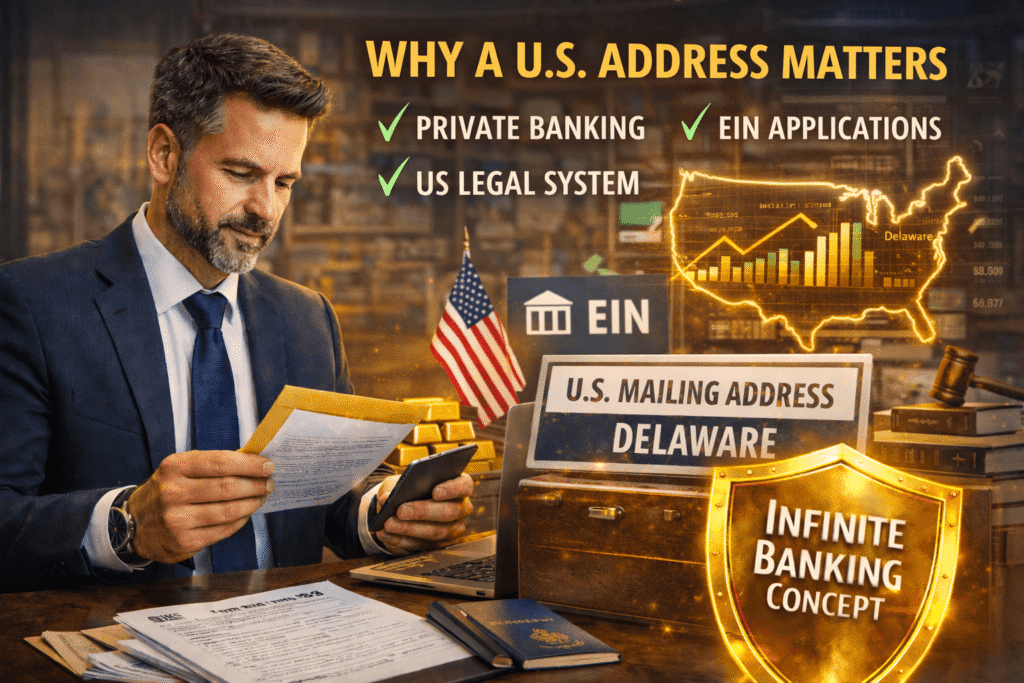
Why a U.S. Address Matters
Establishing a U.S. mailing address significantly simplifies the process of working with American financial infrastructure.
Many administrative processes in the United States require a domestic contact address, especially when applying for identification numbers, opening accounts, or communicating with federal agencies.
Having a legitimate U.S. address helps demonstrate administrative presence, which can reduce friction when interacting with institutions.
In particular, it becomes extremely useful when applying for an Employer Identification Number (EIN) with the Internal Revenue Service (IRS).
Without a U.S. address, certain applications can face delays or additional verification steps.
With a valid address already established, the process typically becomes much smoother.
Step 2 – Applying for an EIN (Employer Identification Number)
Once a U.S. mailing address has been established, the next step is applying for an Employer Identification Number (EIN).
An EIN is issued by the IRS and functions similarly to a tax identification number for entities operating within the United States.
Many international entrepreneurs incorrectly assume that EIN numbers are only available to U.S. citizens.
In reality, non-US residents can also obtain an EIN when the application is structured correctly.
This number is essential for interacting with the U.S. financial system.
What Is an EIN?
An EIN (Employer Identification Number) is issued by the Internal Revenue Service and serves as a unique identifier for entities operating within the United States.
It is commonly used by:
- businesses
- trusts
- partnerships
- certain financial structures
The EIN allows institutions to identify the entity interacting with the financial system.
Without this number, it becomes extremely difficult to open accounts, establish structures, or interact with certain financial services.
How Non-US Residents Apply for an EIN
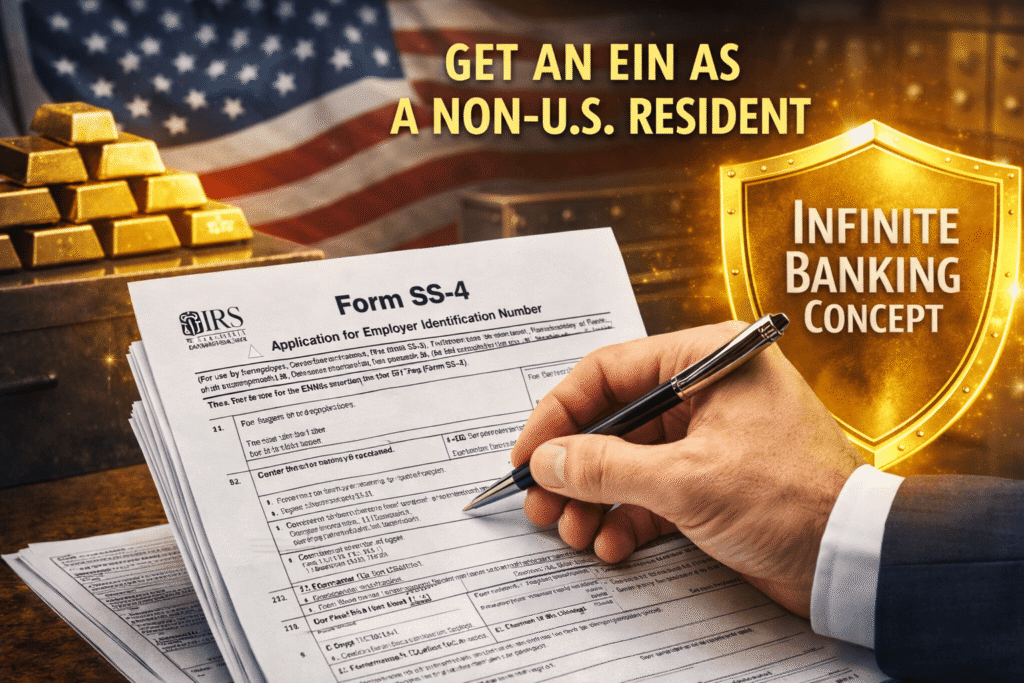
For non-US residents, the EIN application is completed using IRS Form SS-4.
This document requests information about the applicant and the structure being registered.
Depending on the strategy used, the EIN can be issued to:
- a business entity
- a trust
- a financial structure
Because non-US applicants typically cannot use the IRS online EIN system, the SS-4 form is generally submitted by fax directly to the IRS.
After submission, the IRS reviews the application and issues the EIN once the request has been approved.
Processing times vary, but many applicants receive their EIN within a few weeks.
A Complete Guide to Filling Out Form SS-4
For many non-US residents, the most confusing part of the EIN process is correctly completing Form SS-4.
The IRS form contains several sections that are often misunderstood by international applicants.
Common mistakes include:
- incorrect responsible party entries
- inconsistent address information
- wrong classification of entity type
These mistakes can delay the EIN issuance process.
For that reason, I created a complete SS-4 EIN application bundle
The bundle includes:
• A line-by-line explanation of the SS-4 form
• The correct entries for non-US applicants
• A visual walkthrough of the application process
• Instructions for submitting the form to the IRS via fax
By following the correct format, non-US residents can dramatically increase the chances of receiving their EIN without delays.
Do You Need a U.S. Address to Apply for an EIN?
Technically, the IRS does allow EIN applications from foreign applicants without a U.S. address.
However, in practice, many administrative processes become significantly easier when a domestic mailing address is already established.
Having a U.S. address simplifies communication and provides a clear point of contact within the United States.
This is why establishing a U.S. mailing address is generally recommended before submitting the SS-4 application.
Why the EIN Is Important for Infinite Banking
The EIN plays a key role in establishing access to financial services within the United States.
Many financial institutions and insurance companies require a valid identification number before opening accounts or issuing financial products.
Without an EIN, it becomes extremely difficult to interact with many parts of the U.S. financial system.
With an EIN in place, non-US residents can begin interacting with parts of the U.S. financial system that are necessary to structure an Infinite Banking strategy.
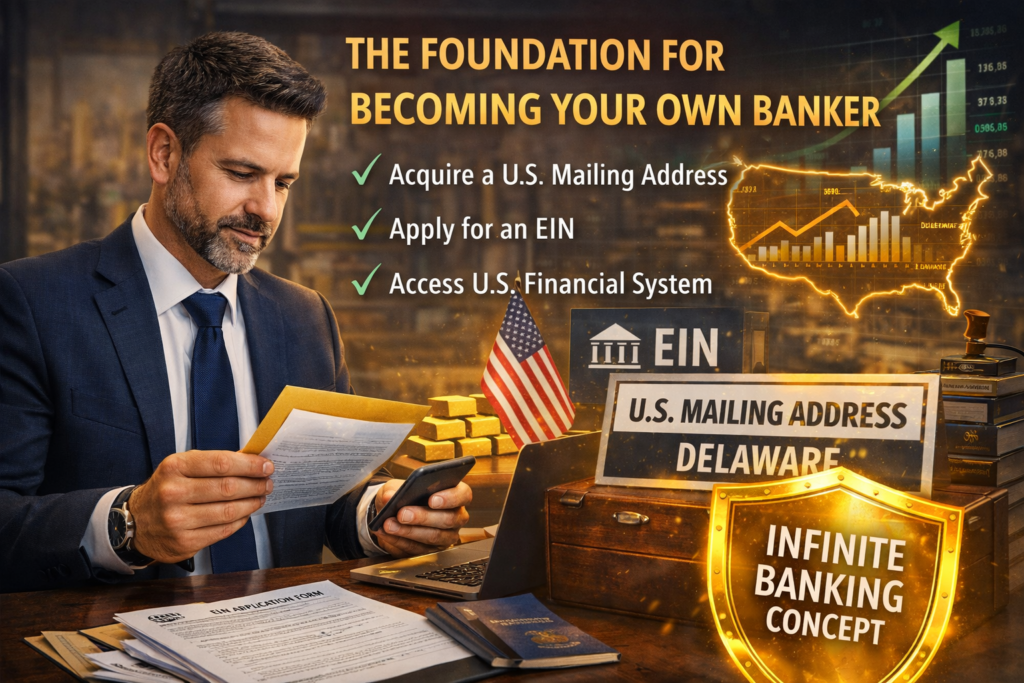
The Foundation for Becoming Your Own Banker
Establishing a U.S. address and obtaining an EIN are not complicated steps, but they are foundational.
They create the administrative bridge that allows non-US residents to participate in financial structures that were traditionally designed for U.S. citizens.
These steps establish a basic financial presence in the United States.
Once these elements are in place, the next phase of the Infinite Banking journey can begin.
That phase involves structuring the financial vehicle that will allow you to:
- store capital
- access liquidity
- finance your own opportunities
In the next part of this guide, we will explain how to structure the legal entity or trust that will interact with U.S. insurance providers.
This is the next crucial step in unlocking the Infinite Banking system as a non-US resident.
Frequently Asked Questions About Infinite Banking for Non-US Residents
Can a foreigner get an EIN from the IRS?
Yes, foreigners can obtain an Employer Identification Number (EIN) from the IRS even if they do not live in the United States. The application must be submitted using IRS Form SS-4. Non-US residents typically submit the form by fax because the IRS online application system requires a Social Security Number.
Once approved, the EIN becomes the identification number used to interact with the U.S. financial system.
Can non-US residents open financial structures in the United States?
Yes, non-US residents can establish various financial structures in the United States depending on their goals. These may include trusts, business entities, or financial accounts used for investment or administrative purposes.
However, most of these processes require certain elements such as:
• a U.S. mailing address
• an EIN issued by the IRS
• the ability to interact with U.S. financial institutions
Once these elements are established, non-US residents can often access many of the same financial tools used by Americans.
Is the Infinite Banking Concept only for Americans?
No. The Infinite Banking Concept itself is not restricted to U.S. citizens. The concept simply relies on financial structures that are widely available within the United States.
When non-US residents establish the necessary administrative connections — such as an EIN and a U.S. mailing address — they may be able to access similar financial strategies.
Why do many international entrepreneurs use Wyoming?
Wyoming is often chosen because it offers strong privacy protections and a relatively simple regulatory structure compared to many other U.S. states.
For international entrepreneurs, Wyoming provides a jurisdiction that balances administrative simplicity with a reputation for respecting financial privacy.
Get Your EIN Without Making Costly Mistakes
Applying for an EIN as a non-US resident can be confusing because the IRS Form SS-4 was not originally designed for foreign applicants.
Many applicants make mistakes that lead to delays or rejected applications.
To simplify this process, I created a complete SS-4 EIN application bundle that shows exactly how non-US residents should complete the form.
The bundle includes:
✔ Line-by-line SS-4 instructions
✔ The correct entries for non-US applicants
✔ Visual examples of completed forms
✔ Instructions for submitting the form to the IRS via fax
If you want to avoid delays and obtain your EIN correctly the first time, this bundle walks you through the entire process step-by-step.