The money in your business account is not all yours. Part of it belongs to the tax office, part of it is already promised to next month’s costs, and part of what clients owe you has not arrived yet. This guide shows a simple way to see what is really safe to spend.
Key Takeaways
- VAT is never yours: the VAT you charge minus the VAT you paid on costs is money you hold for the tax office.
- Reserve on profit, not on turnover: keep a fixed percentage of every payment aside for income tax and social contributions.
- Watch three numbers: safe to spend, money clients owe you (and how late it is), and your runway in months.
Why freelancers run short even in good years
Most freelancers look at one number: the balance of their account. That balance mixes three different kinds of money. There is VAT you collected for the tax office. There is income tax and social contributions you will owe later on this year’s profit. Only what is left after those two is yours.
The second problem is timing. You invoice in one month, the client pays thirty or sixty days later, and your own costs keep running in between. A year can look profitable on paper while your account is empty in March.
Step 1: separate VAT from the start
If you are VAT-registered, every invoice you send contains VAT that you only hold for the tax office. Subtract the VAT you paid on your business costs, and the rest must go back at your next VAT return. Keep that amount apart, ideally in a separate savings account, the day the client pays.
If you are not VAT-registered (for example under a small-business exemption, or in the US), set the VAT rate to 0% and skip this step.
Step 2: reserve a percentage of your profit for tax
Income tax and social contributions are usually calculated on your profit: income minus business costs. You do not know the exact amount until the year is closed, so you reserve a percentage of every payment as it comes in.
Which percentage fits depends on your country, your income and your situation. Ask your accountant for a realistic number once, then apply it to every payment. Being a little too careful is cheap; being short when the tax bill arrives is expensive.
Step 3: calculate what is safe to spend
Now the useful number appears:
Safe to spend = cash received − business costs − VAT to keep aside − tax and social reserves
This is the amount you can pay yourself from. Anything above it is not a bonus; it is money that will leave again.
Step 4: track who owes you, and how late
Late invoices are the most common reason a healthy freelance business runs out of cash. Group your open invoices by how late they are and act per group:
- 1–30 days late: send a friendly reminder with the invoice attached.
- 31–60 days: call the client and agree a payment date in writing.
- 61–90 days: send a formal reminder. In many EU countries you may charge late-payment interest and a fixed recovery fee on business invoices.
- More than 90 days: stop new work for that client and consider a formal demand.
Also check how much of your income comes from one client. If a single client brings in a large share of your turnover, one late payment or one lost contract can hit you hard.
Step 5: know your runway
Your runway is the number of months you could keep going if no new work came in:
Runway = cash you can really use ÷ (what you pay yourself per month + fixed business costs per month)
Many freelancers aim for at least three months. Below that, it makes sense to build a buffer before taking on new risks or big purchases.
Do it by hand, or use a ready-made dashboard
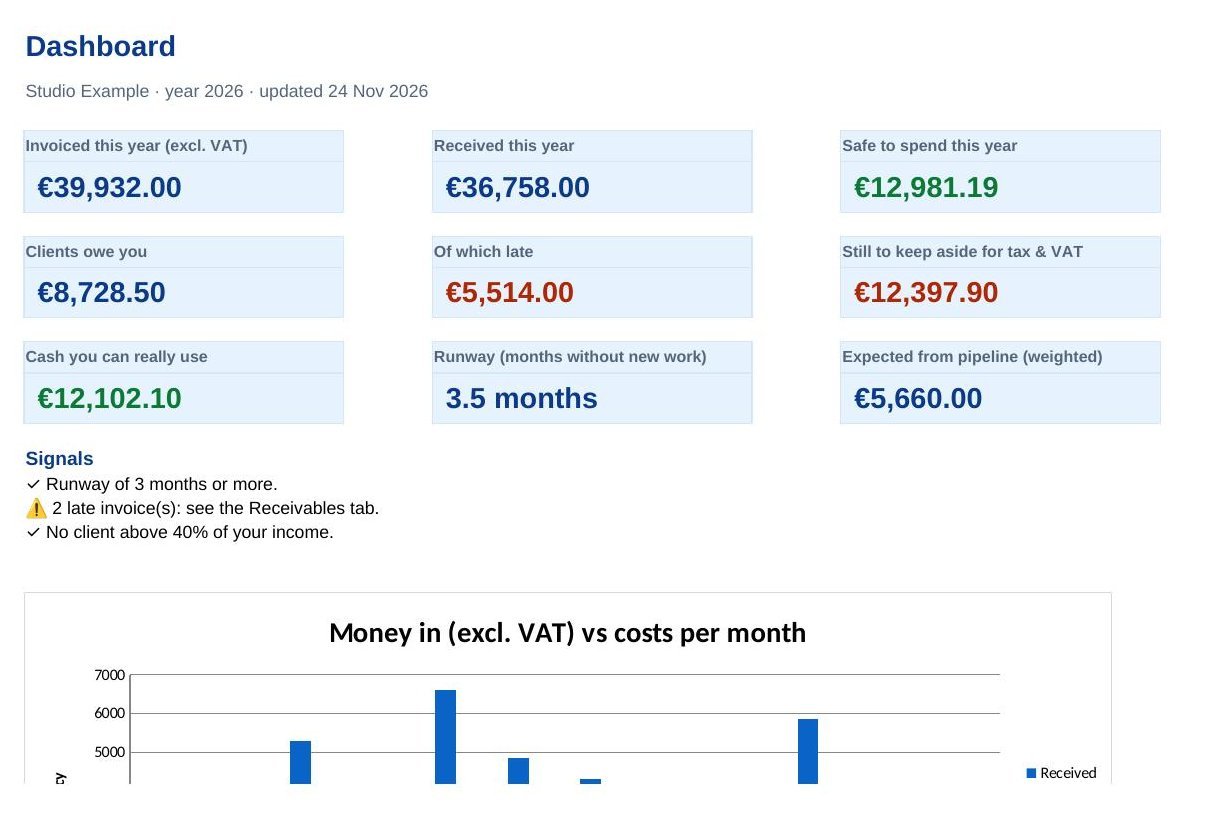
You can do all of this in a simple spreadsheet. If you would rather not build the formulas yourself, we made a workbook that does it for you: you type your invoices and costs, and it calculates your VAT and tax reserves, safe-to-spend amount, late payments per client, runway and a 12-month cash-flow view. It works in Excel and Google Sheets and comes with a filled-in example.
Freelancer Cash-Flow & Tax Reserve Dashboard – €9.99
Everything in this guide, already built: invoices, late payments, VAT and tax reserves, runway and a 12-month cash-flow view. Excel + Google Sheets, with a filled-in example.
Quick checklist
- Move the VAT part of every payment to a separate account the day it arrives.
- Move your tax and social reserve percentage at the same time.
- Pay yourself only from what is safe to spend.
- Check late invoices every week.
- Keep at least a few months of runway.
This guide is general information, not tax, legal or financial advice. Tax and VAT rules differ per country and change over time; check your own situation with an accountant.
Read next
 SiteGround vs Hostinger: 9 Honest Truths for 2026Updated 23 Nov 2026
 US Checking Account Non Resident: 7 Proven Ways to OpenUpdated 23 Nov 2026
 Strategic Investments Secure Future Review 2026: VerdictUpdated 23 Nov 2026
More guides from the Money & Crypto Desk
Get our free Subscription & Bill Cancellation Tracker
Sign up for our weekly email and download the tracker for free: list every subscription, see what it costs you per year, get a renewal calendar and ready-to-send cancellation letters. One short email a week with our latest guides. No spam; unsubscribe with one click.