What Is MenaVPN? Complete Guide to Privacy & Security
What is MenaVPN? This is one of the most common questions users ask when looking for a secure way to protect their internet connection, hide their IP address, and access restricted content safely.
If you’re wondering what is MenaVPN, you’re not alone. Many users are searching for ways to protect their internet connection and stay private online.
In today’s connected world, many users assume that the internet is open, neutral, and freely accessible from anywhere. However, this assumption does not reflect the reality for millions of people across the globe. In regions such as the Middle East, parts of Asia, and other controlled digital environments, internet access is often shaped by layers of restriction, monitoring, and infrastructure-level control.
This creates a fundamentally different online experience—one where access is not guaranteed, privacy is not default, and digital freedom is often limited.
Across these regions, internet traffic frequently passes through centralized systems where Internet Service Providers (ISPs), regulatory bodies, or filtering technologies can monitor and control how data flows. This can result in blocked websites, restricted platforms, or reduced access to global services. In many cases, users searching for topics such as “how to access blocked websites,” “how to browse privately,” or “how to hide my IP address” are responding to these real-world limitations.
The demand for solutions like how to use a VPN for privacy, how to access restricted content, or how to stay anonymous online is not theoretical—it is driven by everyday digital constraints.
From a technical perspective, the internet is not a single, unified system. It is a network of interconnected infrastructures, each governed by different policies, technologies, and control mechanisms. In open environments, these systems operate with minimal interference. In more regulated environments, however, these same systems can be configured to filter, log, or restrict traffic based on predefined rules.
This is where the concept of online privacy becomes critical.
When users connect to the internet without additional protection, their data travels in a relatively exposed state. While modern protocols provide some level of security, they do not fully prevent visibility at various points in the network. This means that user activity—such as browsing behavior, connection metadata, and IP-based location—can still be observed or recorded.
For users searching “is my internet activity being tracked,” “can my ISP see what I do online,” or “how to protect my privacy on public WiFi,” the concern is valid.
In environments where monitoring systems are more active, these concerns become even more relevant.
At the same time, the rise of remote work, mobile connectivity, and cloud-based services has increased the number of access points through which users connect. Smartphones, laptops, and tablets frequently switch between networks—home WiFi, public hotspots, and mobile data connections. Each transition introduces a potential exposure point, especially when security measures are inconsistent or absent.
This dynamic has led to a growing interest in solutions that can provide consistent protection regardless of network conditions.
Search queries such as:
- how does a VPN work for beginners
- best way to protect internet privacy
- how to secure internet connection on public WiFi
- how to use a VPN on mobile phone
are increasing because users are actively looking for ways to regain control over their digital presence.
In this context, a Virtual Private Network (VPN) emerges as one of the most practical and accessible tools available.
A VPN does not change the structure of the internet itself. Instead, it changes how a user interacts with it. By encrypting data and routing it through secure servers, it reduces visibility, limits tracking, and allows users to access content without being directly constrained by their physical location.
This is particularly relevant in regions where users search for:
- how to access blocked apps
- how to unblock websites safely
- how to hide IP address without being tracked
These are not abstract concerns—they are direct responses to the digital environment in which users operate.
The increasing adoption of VPN technology reflects a broader shift in user behavior. People are no longer passive participants in the digital ecosystem. They are becoming more aware of how their data is handled, where their limitations lie, and what tools are available to overcome them.
As a result, VPNs are transitioning from niche tools used by technical users into mainstream solutions adopted by individuals, businesses, and remote workers worldwide.
In regions where internet access is restricted or monitored, this transition happens even faster. The need is immediate, practical, and continuous.
What was once considered optional is now becoming essential.
Understanding this reality is the first step toward understanding why VPN usage is growing, why privacy tools are gaining traction, and why controlling your digital footprint is no longer just a technical concern—but a fundamental part of using the internet today.
What Is MenaVPN and How Does It Work?
In an increasingly controlled digital landscape, many users are actively searching for solutions that allow them to regain privacy, bypass restrictions, and maintain stable access to the global internet. Queries such as “what is MenaVPN,” “is MenaVPN safe to use,” and “how to use a VPN in restricted countries” are becoming more common, especially among users operating in regions where internet access is limited or monitored.
At its core, MenaVPN is a Virtual Private Network service designed to provide a secure and private connection to the internet. Like other VPN solutions, it establishes an encrypted communication channel between your device and a remote server, ensuring that your data remains protected while in transit.
However, to fully understand what MenaVPN is and why it is relevant, it is important to look beyond the basic definition.
MenaVPN is not simply a general-purpose VPN. It is positioned as a solution tailored for users who operate in environments where digital restrictions, surveillance systems, and network-level controls are more prominent. In these contexts, users are not just looking for privacy—they are searching for ways to access blocked websites, hide their IP address, and secure their internet connection in real-world conditions where limitations exist.
From a technical standpoint, MenaVPN functions using the same foundational principles as other modern VPN technologies. When activated, it encrypts your internet traffic using secure protocols, ensuring that data transmitted between your device and the VPN server cannot be read by third parties. At the same time, it replaces your real IP address with that of the VPN server, effectively masking your identity and location.
This dual mechanism—encryption and IP masking—is what allows users to search for and achieve outcomes such as:
- how to browse anonymously online
- how to hide my IP address without being tracked
- how to secure my internet connection on public WiFi
But where MenaVPN distinguishes itself is in its use-case focus.
Rather than targeting only general privacy concerns, it is aligned with users who need practical solutions in environments where access is not always guaranteed. This includes individuals searching for:
- how to access restricted content safely
- how to unblock websites in controlled regions
- how to use a VPN in countries with internet restrictions
In these scenarios, reliability and consistency become just as important as encryption itself.
MenaVPN is therefore positioned to support several key user needs.
First, it enables access to content that may otherwise be unavailable due to geographic or regulatory restrictions. This is particularly relevant for users who rely on global platforms for communication, work, or information.
Second, it enhances privacy in environments where monitoring systems may be more active. By encrypting data and masking identity, it reduces the visibility of user activity across the network.
Third, it provides a more stable and predictable connection in regions where network performance may be affected by filtering or throttling mechanisms. Users searching “how to get a stable VPN connection” or “why is my internet restricted” are often dealing with these exact issues.
Another important aspect is accessibility.
For many users, especially those new to VPN technology, ease of use is critical. Searches like “how to use a VPN for beginners” or “easy VPN setup guide” reflect a demand for solutions that do not require deep technical knowledge. MenaVPN aligns with this need by offering a streamlined user experience, where complex networking processes are handled in the background.
This balance between technical capability and user accessibility is what defines its positioning.
It is not designed solely for advanced users or cybersecurity professionals. Instead, it targets everyday users who need a practical, reliable way to protect their online activity and access the internet without unnecessary barriers.
From a broader perspective, MenaVPN reflects a shift in how VPN services are evolving.
Users are no longer just asking “what is a VPN.”
They are asking:
- which VPN works in restricted countries
- how to stay private online without technical knowledge
- how to access global content safely
This shift moves VPNs from being purely technical tools to becoming essential digital utilities.
MenaVPN fits directly into this category.
It is part of a new generation of VPN services that are designed not only to protect data, but to enable access, maintain stability, and provide control in environments where the default internet experience may be limited.
Understanding what MenaVPN is therefore goes beyond its technical definition.
It is a tool built around a specific need:
👉 restoring privacy
👉 enabling access
👉 and giving users control over how they connect to the internet
How Does MenaVPN Work?
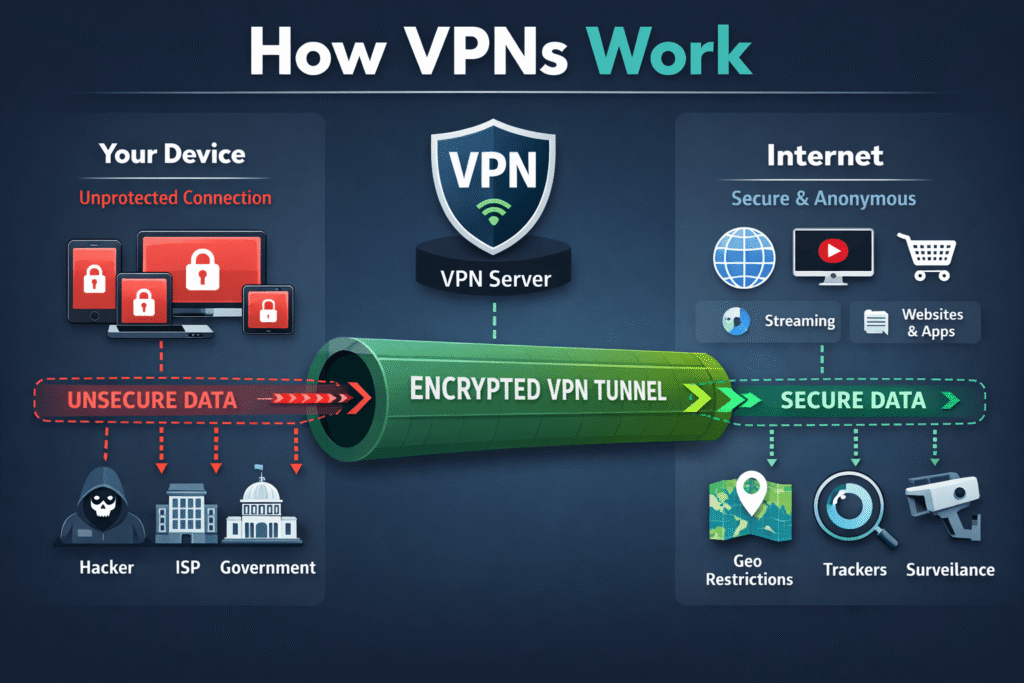
How VPNs Work (Diagram Explanation)
Understanding how MenaVPN works is essential for anyone looking to improve their online privacy, secure their internet connection, or access restricted content safely. Many users search for terms such as “how does a VPN work step by step,” “how does a VPN hide your IP address,” or “how does a VPN protect your data” because they want clarity on what actually happens behind the scenes.
At a fundamental level, MenaVPN operates by creating a secure communication layer between your device and the internet. This layer acts as a protective barrier, ensuring that your data is no longer transmitted in an exposed form, but instead travels through a controlled and encrypted pathway.
When the VPN is activated, a sequence of technical processes begins immediately.
Your device first establishes a connection with a remote VPN server. This server can be located in a different country or region, depending on the configuration you choose. At the same time, MenaVPN initiates an encryption process, converting your outgoing data into a secure format before it leaves your device.
This is where many users searching “how does a VPN encrypt data” or “how secure is a VPN connection” begin to understand the real value.
Instead of sending readable information across the network, MenaVPN transforms your data into encrypted packets that cannot be interpreted by external systems. Even if this data is intercepted during transmission—something that can occur on public networks—it remains unusable without the correct decryption keys.
Once encrypted, your data is routed through the VPN server.
This step is critical.
Rather than connecting directly to a website, your request is first sent to the VPN server, which then forwards it to the destination on your behalf. This process answers a common question users have: “how does a VPN hide your IP address?”
Because the request originates from the VPN server, the destination website sees the server’s IP address instead of your real one. This effectively masks your identity and location, making it significantly more difficult to trace your activity back to your device.
The return data follows the same path in reverse. The website sends the requested information to the VPN server, which then encrypts the data again before transmitting it back to your device through the secure tunnel.
This continuous cycle of encryption, routing, and decryption ensures that your connection remains protected at all times.
For users searching “how VPN tunnel works explained” or “how VPN works diagram explanation,” this process can be visualized as a secure tunnel between your device and the VPN server. All data entering this tunnel is encrypted, travels securely, and exits only after being safely processed by the server.
The result is a browsing experience that is fundamentally different from a standard internet connection.
Without a VPN, your data moves directly across public networks, where it may be visible to various intermediaries. With MenaVPN, your data is encapsulated within a secure layer, significantly reducing exposure to tracking, monitoring, and interception.
This is particularly important for users who search:
- how to browse privately online
- how to protect data on public WiFi
- how to stay anonymous on the internet
Because in these scenarios, the risks are not theoretical—they are practical and immediate.
Another important aspect of how MenaVPN works is its ability to provide location flexibility.
Since your connection is routed through remote servers, you can appear as if you are browsing from a different country. This is why users frequently search for:
- how to access geo-restricted content
- how to unblock websites with VPN
- how to change IP location safely
By selecting different server locations, MenaVPN allows users to bypass regional restrictions while maintaining a secure connection.
From a performance perspective, modern VPN technologies are optimized to balance security and speed. While encryption introduces some overhead, high-quality VPN services are designed to minimize latency and maintain stable connections, even in environments with network limitations.
This is particularly relevant for users dealing with restricted or unstable internet conditions, where maintaining consistent access is a priority.
Ultimately, the way MenaVPN works can be summarized as a coordinated system of processes:
- it encrypts your data before transmission
- it routes your connection through secure servers
- it masks your identity and location
- it protects your activity from external visibility
But more importantly, it changes how you interact with the internet.
Instead of being directly exposed to the network, you operate through a secure layer that gives you control over your data, your identity, and your access.
The Encrypted Tunnel: The Core of MenaVPN
Why Is MenaVPN Important for Online Privacy?
At the heart of understanding how MenaVPN works lies one of the most important concepts in modern network security: the encrypted tunnel. For users searching terms like “what is a VPN tunnel,” “how VPN tunnel works explained,” or “how does a VPN encrypt data,” this is the component that defines the entire value of a VPN connection.
Without this mechanism, a VPN would simply reroute traffic. With it, it becomes a powerful tool for privacy, security, and data protection.
When using MenaVPN, the encrypted tunnel acts as a protected communication channel between your device and the VPN server. Instead of allowing your data to travel openly across the internet, it is first transformed into a secure format before transmission even begins.
This transformation process is what users refer to when searching “how does a VPN encrypt your data” or “how secure is VPN encryption.”
At a technical level, your data is broken down into packets and then encrypted using advanced cryptographic protocols. These protocols convert readable information into ciphertext—an encoded format that cannot be understood without the correct decryption keys. This ensures that your data is no longer visible in its original form as it moves across public networks.
Once encrypted, this data is encapsulated and sent through the VPN tunnel.
This is where the concept of tunneling becomes critical.
Instead of sending individual packets across the network in a way that can be analyzed or intercepted, the VPN groups and protects them within a secure pathway. This answers a common question: “how does a VPN tunnel protect your data?”
The answer lies in isolation.
The tunnel creates a controlled environment within the open internet, preventing external systems from accessing or interpreting the data being transmitted. Even though the data still travels across public infrastructure, it is effectively shielded from visibility.
This becomes particularly important in high-risk environments such as public WiFi networks, where users often search for:
- how to protect data on public WiFi with VPN
- can hackers see my data without a VPN
- how to secure my internet connection on open networks
In these scenarios, the encrypted tunnel acts as a barrier between your data and potential threats.
Even if data packets are intercepted—a scenario that is technically possible in unsecured environments—they remain completely unusable. Without access to the decryption keys, the intercepted information appears as random, meaningless data.
This is why encryption is considered one of the most effective methods for protecting information in transit.
Another key aspect of the encrypted tunnel is data integrity.
Users often ask “can VPN data be changed during transmission” or “how secure is VPN traffic.” The encryption process not only protects confidentiality but also ensures that the data cannot be altered without detection. Any attempt to modify the encrypted packets would invalidate them, preventing successful transmission.
This guarantees that the data you send is the data that is received—unaltered and secure.
From a broader perspective, the encrypted tunnel represents a shift in how data is handled on the internet.
In a standard connection, data is exposed at multiple points along its route. With MenaVPN, that exposure is significantly reduced because the data is never transmitted in a readable form. It exists only as encrypted information until it reaches the secure VPN server, where it can be safely processed.
This is the foundation behind searches such as:
- how to browse securely online
- how to stay anonymous on the internet
- how VPN protects your privacy
Because in each of these cases, the answer ultimately leads back to the same mechanism: secure data transmission through encryption.
A useful way to conceptualize the encrypted tunnel is to imagine sending a message through a public system, but instead of writing it in plain language, you encode it in a way that only the intended recipient can understand. The route remains visible, but the content is protected.
That is exactly what MenaVPN achieves at a network level.
It does not hide the existence of your connection—but it ensures that the content of that connection remains private, secure, and inaccessible to unauthorized parties.
In doing so, the encrypted tunnel becomes more than just a technical feature. It becomes the core mechanism that enables privacy, protects identity, and secures your digital footprint in an environment where exposure is otherwise the default.
How to Set Up MenaVPN
For many users, one of the most common questions is not just “what is a VPN,” but “how to set up a VPN quickly and safely.” Searches such as “how to set up a VPN for beginners,” “how to install a VPN on any device,” and “how to use a VPN step by step” reflect a clear intent: users want a solution that is both effective and easy to implement.
This is where MenaVPN is designed to stand out.
Unlike traditional network configurations that require technical knowledge, MenaVPN follows a streamlined and user-friendly setup process. The goal is to eliminate complexity while still delivering a fully secure connection.
Once the application is downloaded and installed, the system handles most of the technical operations automatically. This includes selecting the appropriate encryption protocols, establishing a secure connection to the nearest or most optimal server, and configuring the routing of your internet traffic.
This simplicity directly addresses user concerns such as:
- how to set up a VPN without technical knowledge
- easy VPN setup guide for beginners
- how to connect to a VPN in seconds
From the user’s perspective, the process is reduced to a few straightforward steps. After launching the application and logging into your account, you can select a server location based on your needs—whether that is for privacy, speed, or accessing region-specific content. Once a server is selected, activating the VPN connection initiates the entire security process.
Behind this simple interaction, multiple layers of technology are activated simultaneously.
Your connection is encrypted, your IP address is replaced with that of the VPN server, and your data is routed through a secure tunnel. All of this happens in real time, without requiring manual input from the user.
This answers a key question many people have: “does a VPN protect all my internet traffic automatically?”
With MenaVPN, the answer is yes.
Once connected, all outgoing and incoming data is secured through the VPN layer. This includes browser activity, applications, background processes, and any data transmitted over the network. Users searching “how to protect all internet traffic with a VPN” or “does a VPN work for all apps” will find that the protection is comprehensive.
For more advanced users, MenaVPN may offer additional configuration options.
These can include selecting specific protocols such as OpenVPN, WireGuard, or IKEv2, adjusting connection preferences, or optimizing server selection based on performance requirements. This level of control is particularly useful for users who search:
- which VPN protocol is fastest
- how to optimize VPN speed
- best VPN settings for performance
However, what makes MenaVPN effective is that these advanced options are not required for basic use.
The default configuration is designed to provide a balanced combination of security, speed, and reliability, making it accessible for users at all levels.
Another important consideration in the setup process is device compatibility.
Modern users often search:
- how to set up VPN on mobile phone
- how to install VPN on laptop or tablet
- how to use VPN on multiple devices
MenaVPN is designed to function across multiple platforms, allowing users to maintain consistent protection regardless of the device they are using. This is particularly important in today’s environment, where users frequently switch between smartphones, laptops, and other connected devices.
Once the VPN connection is active, the transition to a secure browsing environment is immediate.
Your internet activity is no longer exposed in its original form. Instead, it is encapsulated within an encrypted tunnel, routed through secure servers, and protected from external visibility.
This transformation is what users are ultimately searching for when they ask:
- how to secure my internet connection
- how to browse privately online
- how to stay safe on public WiFi
The setup process is simply the entry point.
What follows is a continuous layer of protection that operates in the background, allowing users to interact with the internet without constantly worrying about exposure, tracking, or interception.
In this sense, setting up MenaVPN is not just a technical step—it is the moment where a standard, exposed connection is replaced by a controlled, secure, and private digital environment.
How MenaVPN Works on Mobile Devices
Mobile VPN Explained
As mobile usage continues to dominate global internet traffic, more users are searching for ways to protect their data on smartphones. Queries such as “how does a VPN work on a cell phone,” “how to use a VPN on mobile data,” and “is a VPN necessary on a smartphone” reflect a growing awareness that mobile devices are just as exposed—if not more—than traditional computers.
In this context, MenaVPN plays an even more critical role.
Unlike desktop systems, smartphones are constantly moving between different network environments. A single device may connect to a home WiFi network, switch to public WiFi in a café, then transition to 4G or 5G mobile data—all within a short period of time. Each of these transitions introduces a new level of risk, particularly when security standards vary between networks.
This is why users frequently search:
- how to protect my phone on public WiFi
- can hackers access my phone data on open networks
- how to secure mobile internet connection
The concern is valid.
Public WiFi networks, in particular, are known for their lack of security. Without proper protection, data transmitted over these networks can be intercepted, monitored, or analyzed. This includes sensitive information such as login credentials, personal data, and browsing activity.
When MenaVPN is activated on a mobile device, it establishes a continuous layer of protection that operates regardless of the network being used.
All outgoing data—whether generated by your browser, mobile applications, or background processes—is encrypted before it leaves your device. This means that even if the data is transmitted over an unsecured network, it cannot be read or interpreted by third parties.
This directly addresses common searches such as:
- how does a VPN protect mobile data
- does a VPN work for apps on your phone
- how to encrypt internet connection on smartphone
In addition to encryption, MenaVPN also masks your IP address.
This is particularly important on mobile devices, where location tracking can be more precise due to the combination of network data and device identifiers. By replacing your real IP address with that of the VPN server, MenaVPN prevents websites and external systems from directly linking your activity to your physical location.
This is why users often search:
- how to hide IP address on phone
- how to stay anonymous on mobile internet
- can a VPN hide my location on smartphone
Another key advantage of using MenaVPN on mobile devices is connection consistency.
As smartphones switch between networks, a properly configured VPN maintains the encrypted tunnel without interruption. This ensures that your connection remains secure even during transitions, reducing the risk of exposure during moments when protection would otherwise drop.
This feature is particularly relevant for users searching:
- does a VPN stay on when switching networks
- how to keep VPN active on mobile data
- is VPN always on safe for smartphone
From a usability perspective, mobile VPN applications are designed to be simple and intuitive.
Users can activate protection with a single tap, while the application handles encryption, server selection, and routing automatically. This aligns with searches such as:
- easy VPN app for mobile
- how to use VPN on phone step by step
- best way to secure smartphone internet
Despite this simplicity, the underlying technology remains robust.
MenaVPN ensures that all data—regardless of its source—is processed through the same secure channel. This includes messaging apps, email services, cloud storage, and any application that relies on internet connectivity.
This comprehensive coverage is what makes mobile VPN usage essential in today’s environment.
Without a VPN, a smartphone operates as a highly connected but exposed device, constantly interacting with multiple networks and services. With MenaVPN, that same device becomes part of a secured communication system, where data is protected, identity is masked, and exposure is significantly reduced.
In practical terms, using MenaVPN on a mobile device transforms how you interact with the internet.
Instead of adapting your behavior based on the risks of each network, you maintain a consistent level of security and privacy—regardless of where or how you connect.
What MenaVPN Protects
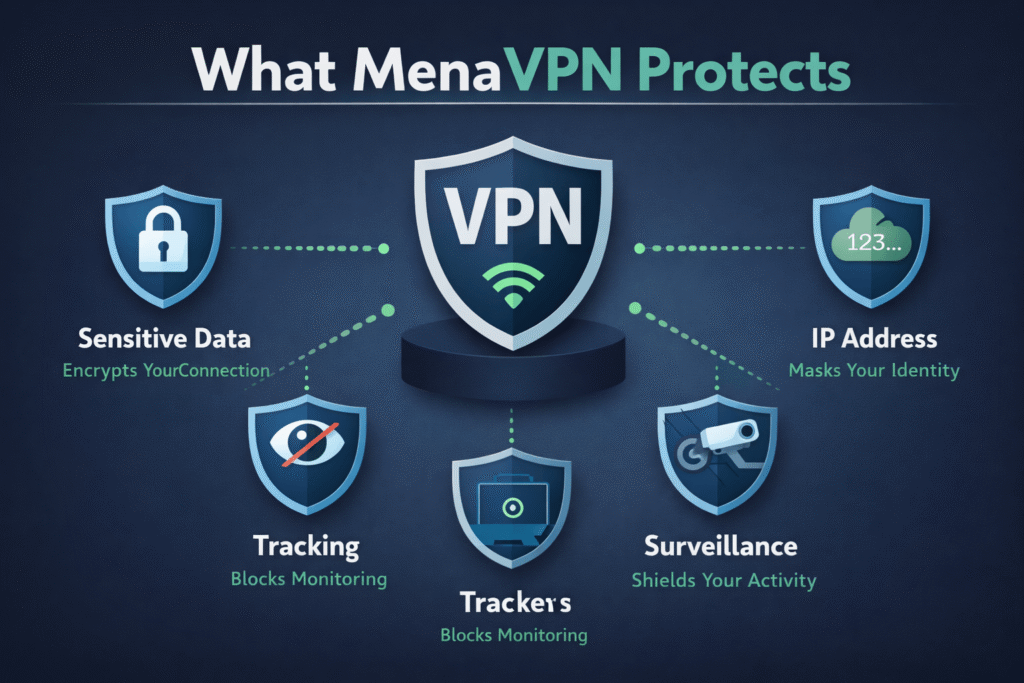
Understanding what MenaVPN protects is essential for users who are actively searching for ways to secure their internet connection, protect their personal data, and reduce their exposure to tracking systems. Queries such as “what does a VPN protect,” “can a VPN protect my data,” and “how to stay private online” reflect a growing concern about how information is handled in today’s digital environment.
At its core, MenaVPN is designed to protect your data while it is being transmitted across networks. This stage—often referred to as “data in transit”—is one of the most vulnerable points in any internet connection. Without proper protection, information traveling between your device and external servers can potentially be observed, intercepted, or logged.
This is why users frequently search:
- how to protect data on public WiFi
- can hackers see my internet activity
- how to stop tracking online
MenaVPN addresses these concerns by introducing a secure layer that shields your data from external visibility.
When the VPN is active, all outgoing and incoming traffic is encrypted before it leaves your device. This means that even if data packets are intercepted during transmission—whether on public networks or through monitoring systems—they cannot be read or interpreted. This directly answers a common question: “can a VPN prevent data interception?”
Yes, because the data is no longer transmitted in a readable format.
In addition to protecting the content of your data, MenaVPN also plays a crucial role in preventing tracking and monitoring.
Modern internet systems rely heavily on tracking mechanisms to identify users, analyze behavior, and collect data. These systems often use IP addresses as a primary identifier. When you connect to the internet without a VPN, your real IP address is visible, allowing websites, advertisers, and other entities to associate your activity with your location and identity.
This is why users search:
- how to hide my IP address online
- how to stop websites from tracking me
- how to browse anonymously on the internet
MenaVPN solves this by masking your IP address through a process known as IP obfuscation.
Instead of your real IP, external systems see the IP address of the VPN server. This breaks the direct link between your online activity and your physical location, making it significantly more difficult to track or profile your behavior.
Another important layer of protection is defense against surveillance systems.
In environments where network monitoring is more active, user activity may be logged or analyzed at various points within the infrastructure. This includes ISPs, network administrators, or other entities with access to data flow.
By encrypting your connection, MenaVPN reduces the visibility of your activity within these systems. While it does not eliminate the existence of your connection, it ensures that the content of your communication remains private.
This is particularly relevant for users searching:
- can my ISP see what I do online
- how to stop ISP tracking
- how to protect browsing history from monitoring
In addition to surveillance protection, MenaVPN also limits exposure to third-party tracking mechanisms.
Many websites and online services use tracking technologies to collect data on user behavior, often for advertising or analytics purposes. While a VPN does not block all forms of tracking (such as cookies or browser-based tracking), it significantly reduces the ability to track users based on IP address and network-level data.
This contributes to a broader sense of privacy, where users are less visible across different systems.
Another important aspect of what MenaVPN protects is connection integrity.
Users often ask “can my data be changed during transmission” or “how secure is my internet connection.” Through encryption, the VPN ensures that data cannot be altered without detection. Any attempt to modify the encrypted packets would invalidate them, preventing successful transmission and protecting the integrity of the communication.
From a broader perspective, MenaVPN creates a controlled environment where your data is:
- encrypted before transmission
- shielded from interception
- hidden from tracking systems
- protected against monitoring
- separated from your real identity
This combination of protections significantly reduces your exposure in an otherwise open and observable network environment.
However, it is important to understand the scope of this protection.
MenaVPN is designed to secure your connection and protect your data in transit. It does not replace other forms of cybersecurity, such as antivirus software or safe browsing practices. Instead, it acts as a critical layer within a broader security strategy.
For users searching:
- how to protect my internet connection completely
- best way to stay safe online
- how to improve online privacy
the answer is not a single tool—but a combination of solutions working together.
Within that combination, MenaVPN plays a central role.
It ensures that your data is no longer exposed as it travels across networks, that your identity is no longer directly visible, and that your activity is significantly harder to monitor or track.
In a digital environment where exposure is the default, this level of protection is not just beneficial—it is essential.
Why MenaVPN Is Gaining Popularity
The increasing popularity of MenaVPN is not случай—it’s a direct reflection of how the internet itself is evolving. As digital infrastructure becomes more complex and, in many regions, more controlled, users are actively searching for ways to regain access, protect their data, and maintain privacy online.
Search queries such as “why do people use VPNs,” “best VPN for restricted countries,” and “how to access blocked websites safely” have grown steadily over the past years. This trend highlights a shift in user behavior: people are no longer passive users of the internet—they are actively looking for tools that give them control.
One of the primary drivers behind MenaVPN’s growth is the increasing presence of internet restrictions and monitoring systems in certain regions. In parts of the Middle East, Asia, and other regulated environments, access to global platforms, communication tools, and online services is not always guaranteed.
This leads users to search for solutions such as:
- how to unblock websites in restricted countries
- how to use VPN where it is restricted
- how to access global content safely
These are not theoretical searches—they reflect real, everyday limitations.
MenaVPN directly addresses these challenges by providing a secure pathway that allows users to bypass restrictions while maintaining privacy. By encrypting data and routing traffic through external servers, it enables access to content that would otherwise be unavailable within certain network environments.
Another key factor contributing to its popularity is the growing awareness of online privacy risks.
Users are becoming increasingly aware that their data is being tracked, analyzed, and sometimes stored by various systems. This awareness is driving searches like:
- how to protect my privacy online
- can my ISP track my activity
- how to stay anonymous on the internet
As a result, VPNs are no longer seen as niche tools for advanced users. They are becoming mainstream solutions for anyone who wants to reduce their digital footprint and protect their personal information.
MenaVPN benefits from this shift by positioning itself as an accessible solution for users who may not have technical expertise but still require effective protection.
Ease of use plays a critical role here.
Many users searching “easy VPN for beginners” or “how to use a VPN without technical knowledge” are looking for tools that do not require complex configuration. MenaVPN aligns with this demand by offering a simplified interface where users can establish a secure connection quickly and without difficulty.
This balance between simplicity and functionality is a major factor in its growing adoption.
Another important driver is the rise of mobile internet usage.
With more people accessing the internet through smartphones, the need for consistent protection across multiple networks has increased. Users frequently search:
- how to protect mobile data with VPN
- VPN for public WiFi safety
- how to secure phone internet connection
Since mobile devices are often connected to unsecured networks, the risk of exposure is higher. MenaVPN provides a continuous layer of protection that remains active regardless of network changes, making it particularly valuable in mobile-first environments.
In addition to privacy and security, accessibility to global content is another key reason behind its popularity.
Users around the world are looking for ways to bypass geo-restrictions and access services that may not be available in their region. This includes streaming platforms, communication tools, and information sources.
Searches such as:
- how to access geo-restricted content
- how to change IP location with VPN
- how to unblock apps in restricted countries
are all indicators of this demand.
By allowing users to connect through servers in different locations, MenaVPN provides the flexibility needed to overcome these barriers.
From a broader perspective, the rise of MenaVPN reflects a deeper transformation in how people interact with the internet.
Users are no longer satisfied with a limited or controlled experience. They want:
- freedom of access
- control over their data
- protection from tracking and monitoring
This shift is driving the adoption of tools that can provide these capabilities in a practical and accessible way.
MenaVPN fits directly into this emerging demand.
It is not just a tool for privacy—it is a response to a changing digital environment where users are actively seeking solutions to regain control over their online experience.
In this sense, its growing popularity is not just about technology.
It is about the increasing need for digital autonomy.
And as this need continues to expand, VPN solutions like MenaVPN are likely to become even more integrated into how users navigate the internet—moving from optional tools to essential components of everyday connectivity.
Strategic Perspective
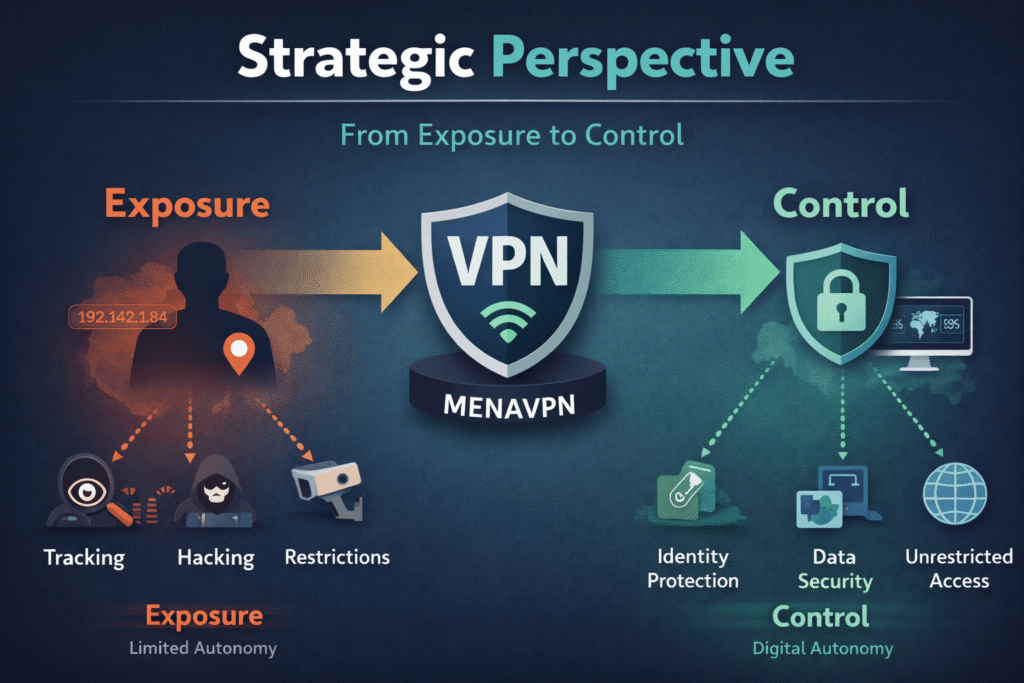
From a broader strategic perspective, MenaVPN represents far more than a conventional privacy tool. It reflects a fundamental shift in how users approach the internet itself. As digital environments become increasingly complex—shaped by data collection systems, geographic restrictions, and network-level controls—users are no longer simply consuming content. They are actively searching for ways to redefine how they interact with the internet.
This shift is evident in the types of questions users are asking today. Queries such as “how to take control of your online privacy,” “how to browse the internet without being tracked,” and “how to access the internet without restrictions” highlight a growing demand for autonomy in digital spaces.
At its core, MenaVPN addresses this demand by transforming the user’s position within the network.
In a standard internet connection, visibility is the default. Your IP address, location, and activity can be observed or inferred through various systems. This creates an environment where users are continuously exposed—often without realizing the extent of that exposure.
MenaVPN changes this dynamic.
By introducing an encrypted communication layer and routing traffic through secure servers, it shifts the user from a passive participant to an active controller of their digital presence. This directly aligns with searches such as:
- how to control your data online
- how to stay anonymous on the internet
- how to protect your digital identity
Control over identity is one of the most immediate outcomes.
Instead of being directly identified through a real IP address, users operate behind the VPN server’s identity. This breaks the direct link between online activity and physical location, reducing the effectiveness of tracking systems that rely on consistent identification.
This is why users search:
- how to hide IP address completely
- how to browse anonymously online
- can a VPN make you anonymous
Control over data is equally significant.
In a typical connection, data is transmitted in a way that can be partially observed or logged at various points in the network. With MenaVPN, this data is encrypted before transmission, ensuring that it remains unreadable throughout its journey.
This addresses concerns such as:
- how to protect personal data online
- how to secure internet connection from hackers
- how to encrypt internet traffic
Control over access introduces another dimension.
Geographic restrictions, content filtering, and network limitations can shape what users are able to see and interact with online. By routing traffic through different server locations, MenaVPN allows users to bypass these limitations, effectively expanding the scope of accessible content.
This aligns with searches like:
- how to access blocked websites
- how to bypass geo restrictions safely
- how to change IP location with VPN
Taken together, these elements form a new model of interaction—one where the user is no longer constrained by the default structure of the internet.
Instead of adapting to restrictions, users can redefine the conditions under which they connect.
From a strategic standpoint, this represents a shift toward digital autonomy.
Users are no longer satisfied with limited visibility into how their data is handled or where their access is restricted. They are actively seeking tools that allow them to:
- control their online presence
- protect their personal information
- access the internet without imposed limitations
MenaVPN fits directly into this emerging need.
It provides a practical, accessible way to implement these capabilities without requiring advanced technical knowledge. This is particularly important for users searching:
- how to improve online privacy easily
- best tools for internet privacy beginners
- how to secure internet connection without complexity
From a long-term perspective, this trend is likely to continue.
As awareness of privacy, security, and digital rights increases, tools like MenaVPN are expected to become more integrated into everyday internet usage. What was once considered optional is gradually becoming part of the baseline expectation for secure and unrestricted connectivity.
In this context, MenaVPN is not just a response to current challenges—it is part of a broader evolution in how users define their relationship with the internet.
It enables a transition from exposure to control, from limitation to access, and from passive usage to intentional, secure interaction with the digital world.