What Is a VPN? A Complete Technical & Practical Guide (2026)
The Reality of the Modern Internet
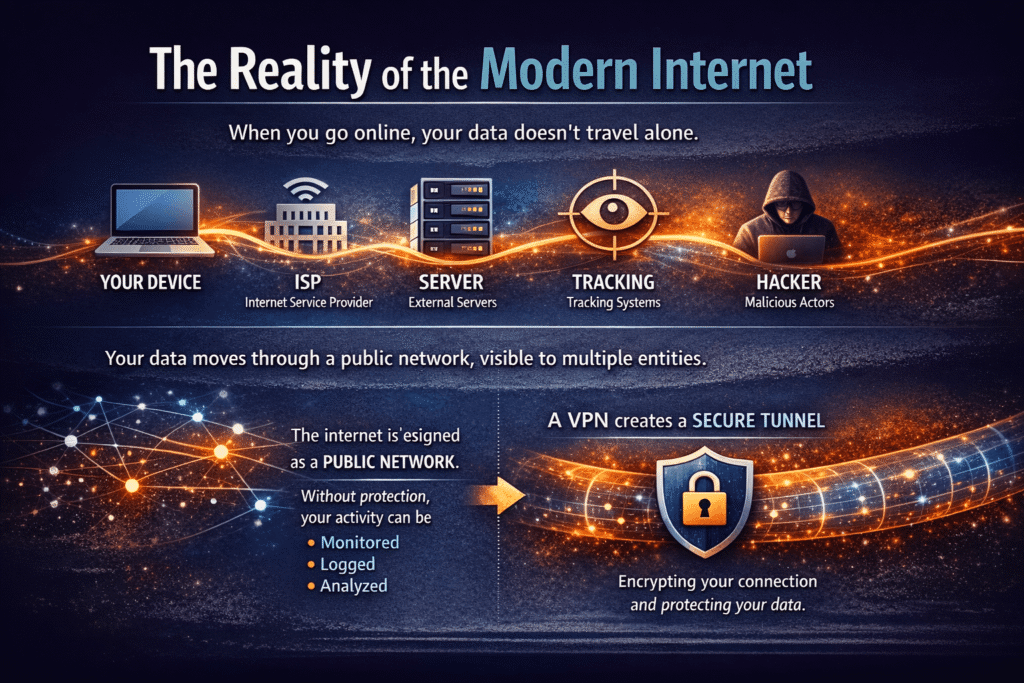
Every time you connect to the internet, you are not entering a private environment—you are stepping into a vast, interconnected system where your data moves through multiple layers of infrastructure before reaching its destination. Internet service providers, external servers, content delivery networks, tracking frameworks, and sometimes even malicious actors all exist along this path.
This exposure is not accidental. It is fundamental to how the internet was engineered.
The internet operates as a public network, designed for openness and interoperability rather than confidentiality. When you send a request—whether it’s loading a website, streaming content, or sending data—it is broken into packets and routed through various nodes across global networks. At each stage, there is potential visibility into that data, depending on how it is handled and secured.
Without protective measures in place, this flow of information can be observed, recorded, and analyzed. Service providers can log activity, third-party systems can track behavior, and unsecured networks can expose sensitive data to interception.
This is the baseline reality of modern connectivity.
A VPN introduces a controlled layer into this process. Instead of allowing your data to move openly through these systems, it encrypts and redirects your traffic through a secure channel—reducing exposure and limiting who can access or interpret your information.According to the European Data Protection Board, user data is constantly processed across multiple systems.
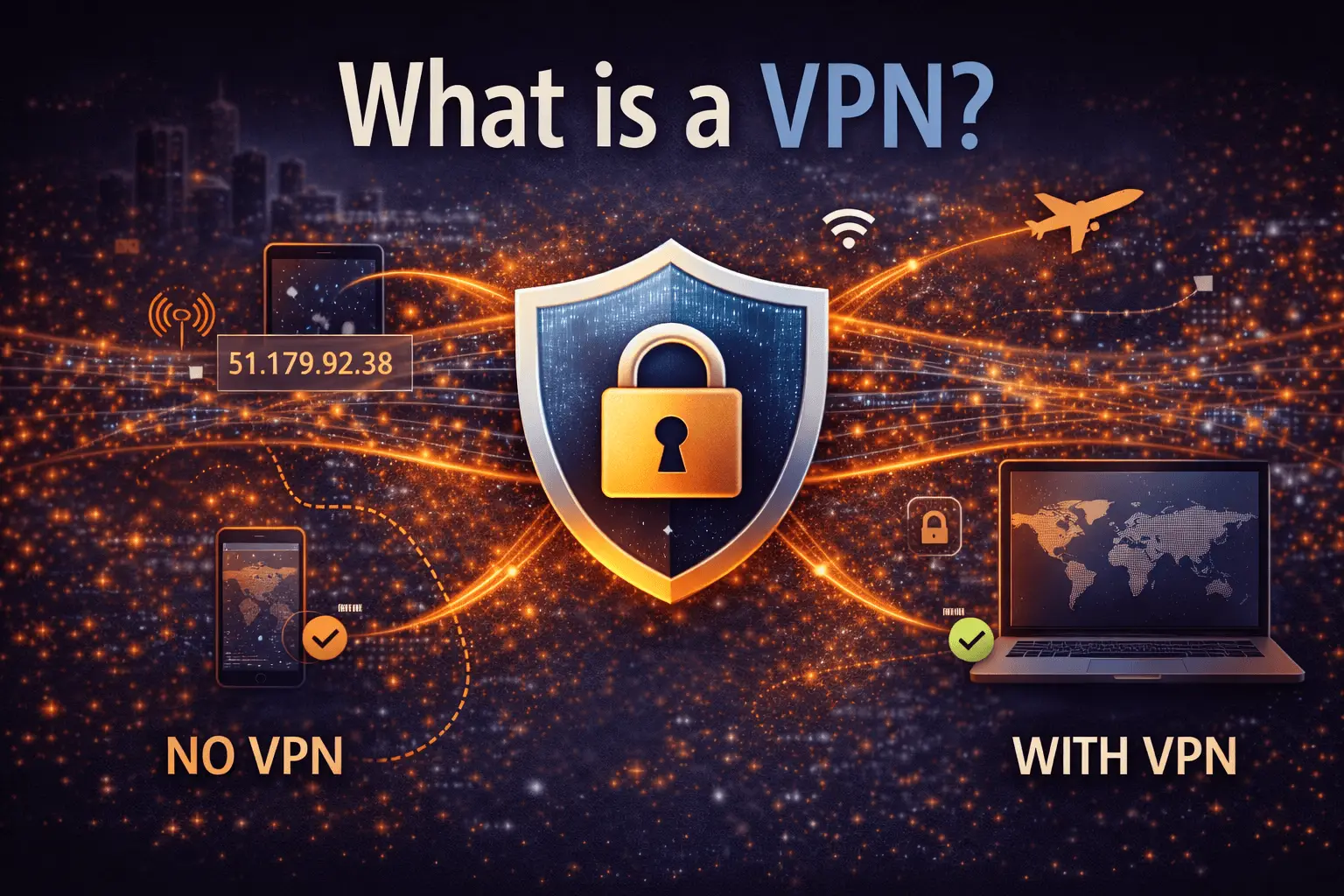
What Is a VPN?
From a technical perspective, a VPN operates as an overlay network—a private, controlled layer that sits on top of the existing public internet infrastructure. It does not replace the internet or alter its underlying protocols; instead, it redefines how your data is packaged, transmitted, and exposed as it moves across that infrastructure.
In a standard connection, your data travels openly between your device and external servers, making it visible—at least in part—to various intermediaries along the route. A VPN changes this dynamic by encapsulating your traffic within an encrypted tunnel before it ever leaves your device. This means that while the data still traverses the same public pathways, its contents and origin are effectively shielded.
The result is a dual-layer structure: the public network continues to handle the physical transmission of data, while the VPN layer enforces privacy, encryption, and controlled routing. To external observers, the communication appears to originate from the VPN server rather than the user, and the data itself remains unreadable without the proper decryption keys.
In essence, a VPN does not make the internet private—it makes your interaction with it private.
How Does a VPN Work?
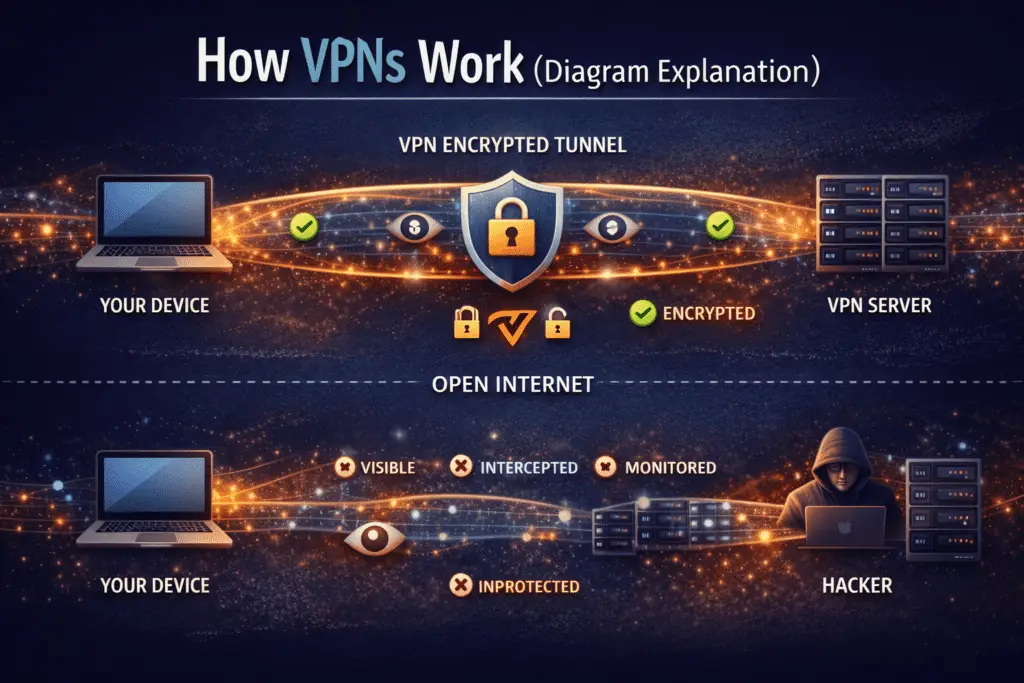
How VPNs Work (Diagram Explanation)
Understanding how a VPN works requires looking at the flow of data:
When you activate a VPN, your device establishes a secure connection with a remote server. Your data is encrypted before it leaves your device, then sent through a protected tunnel.
The VPN server receives this encrypted data, decrypts it, and forwards it to the destination website. The response is then sent back through the same secure tunnel.
From the outside, it appears as if the VPN server—not you—is making the request.
This is why your real IP address and location remain hidden.
How VPN Tunnel Works
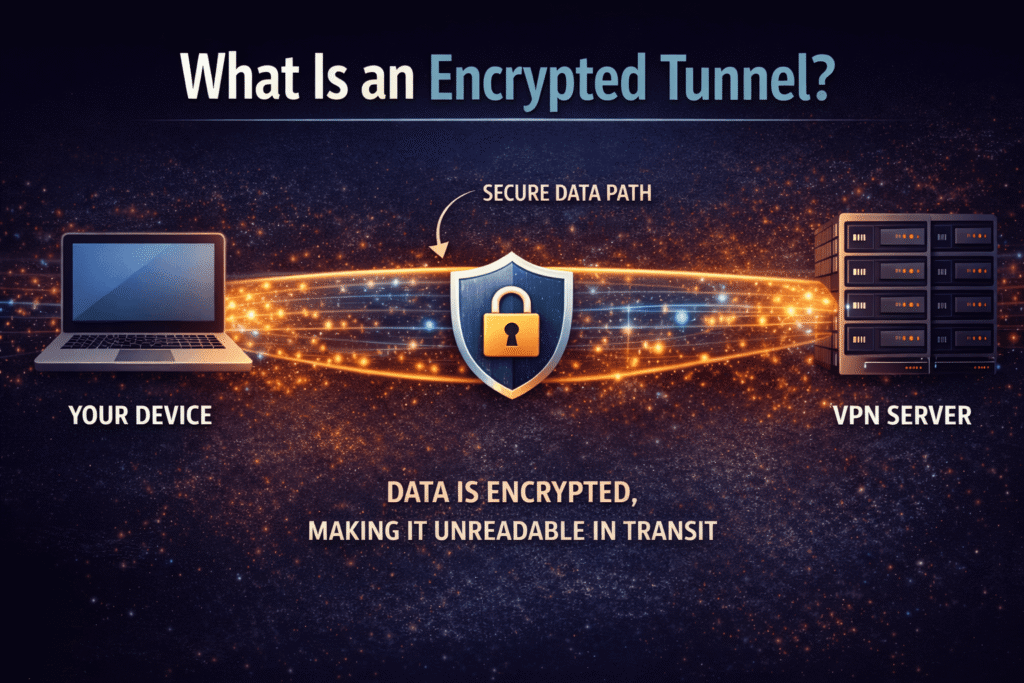
What Is an Encrypted Tunnel?
At the heart of every VPN lies its most critical component: the encrypted tunnel. This is the mechanism that transforms an exposed, public data transmission into a protected and controlled flow of information.
A VPN tunnel can be understood as a secure, encapsulated pathway established between your device and a remote VPN server. Rather than allowing your data to travel openly across the internet, the VPN restructures how that data is handled from the moment it leaves your device.
Instead of transmitting raw, readable information, the VPN first encapsulates your data into protected packets. These packets are then encrypted using advanced cryptographic algorithms, effectively converting human-readable information into ciphertext. Once secured, this data is transmitted through the tunnel, isolated from external visibility as it moves across public networks.
This process fundamentally changes the risk profile of your connection. Even if data packets are intercepted during transmission—a common possibility on unsecured or shared networks—they remain unintelligible without the corresponding decryption keys. In practical terms, the data becomes useless to anyone attempting to access it without authorization.
The encrypted tunnel therefore serves two essential functions simultaneously: it conceals the contents of your communication and protects the integrity of the data in transit. It ensures that what leaves your device arrives at its destination without being exposed, altered, or understood by unintended parties.
A useful way to conceptualize this is to imagine sending a sealed and coded message through a public postal system. The route remains visible, and the message still passes through multiple hands, but the contents are locked, unreadable, and protected from interference.
How to Set Up a VPN
Setting up a VPN is far less complex than most people assume. What once required manual network configuration and technical expertise has been streamlined into a process that is largely automated and accessible to any user, regardless of experience level.
In its most common form, configuring a VPN simply involves installing a dedicated application on your device. Once installed, the software handles the underlying complexity—establishing secure connections, selecting appropriate protocols, and managing encryption in the background. From the user’s perspective, the process is reduced to initiating a connection, often with a single action.
Behind this simplicity, however, several important steps take place. A reliable VPN service must first be selected, as the provider determines the quality of the infrastructure, security standards, and privacy policies. The VPN client is then installed, creating the interface through which connections are managed. After authentication—typically through account credentials—the user can choose a server location, effectively determining the geographic point from which their traffic will appear to originate. Once the connection is activated, the VPN establishes a secure tunnel and begins routing all internet traffic through it.
For more advanced users, manual configuration remains an option. Modern operating systems support direct VPN setup using protocols such as OpenVPN, WireGuard, or IKEv2. This approach allows for greater control over connection parameters, security configurations, and network behavior, but it requires a deeper understanding of networking concepts.
Regardless of the method used, the outcome is the same: once the VPN connection is active, all outgoing and incoming data is automatically encrypted and transmitted through a secure channel. From that point forward, the user’s internet activity is no longer exposed in its original form, but protected within a controlled and private communication layer.
How Does a VPN Work on a Cell Phone?
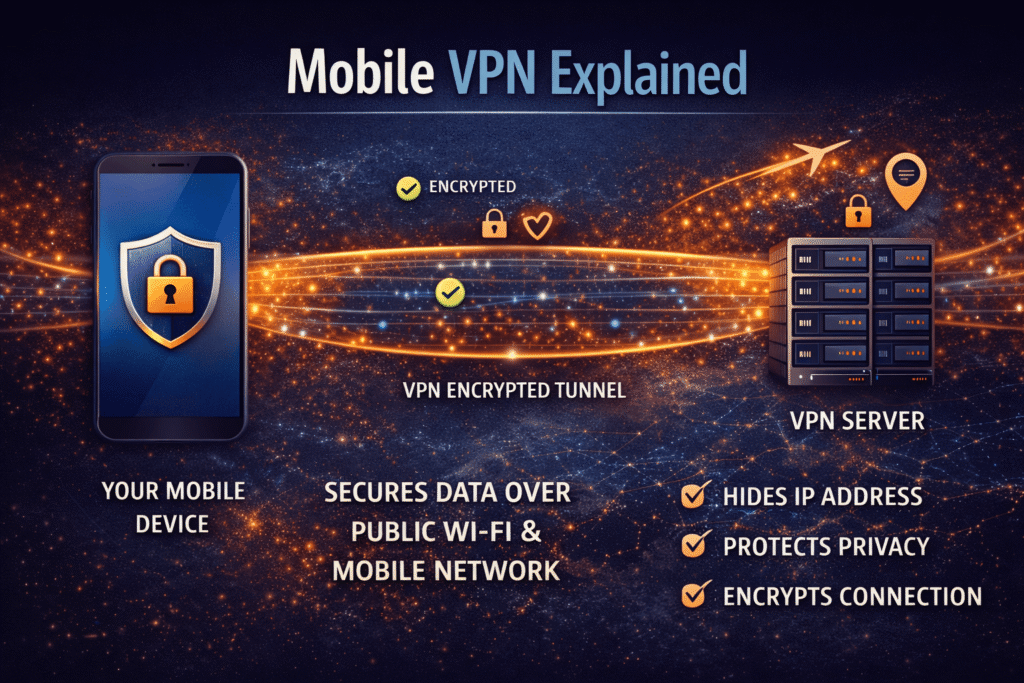
Mobile VPN Explained
A VPN on a mobile device operates on the same foundational principles as it does on a desktop system, but its role becomes even more critical due to the way smartphones interact with networks. Unlike computers that typically remain connected to a single, stable network, mobile devices are constantly transitioning between environments—shifting from private WiFi to public hotspots, and from cellular networks such as 4G and 5G to unsecured connections in cafés, airports, and hotels.
Each of these transitions introduces potential exposure points. Every time a device connects to a new network, it enters a different security context, often without the user being fully aware of the risks involved.
When a VPN is active on a smartphone, it establishes a continuous layer of protection that remains intact regardless of the network being used. All data generated by applications—whether it’s browsing activity, messaging, or background processes—is encrypted before it leaves the device. This ensures that the information cannot be read or intercepted during transmission.
At the same time, the device’s real IP address is replaced by that of the VPN server, effectively masking the user’s identity and location. This prevents external systems from directly associating activity with the physical device or its network origin.
Perhaps most importantly, the VPN maintains this protection seamlessly across network changes. Whether the device switches from WiFi to mobile data or connects to a new hotspot, the encrypted tunnel remains active, preserving the integrity and confidentiality of the connection.
This becomes especially significant in public environments, where unsecured networks are common and the risk of data interception is substantially higher. In such scenarios, a VPN transforms an otherwise vulnerable connection into a secured communication channel, ensuring that sensitive information remains protected even in high-risk conditions.
Core Components of VPN Technology
A VPN is far more than a simple application you install on your device—it is a layered architecture designed to control, secure, and manage how your data moves across the internet. Each component within this system plays a distinct role, and only when they operate together does a VPN deliver true privacy and security.
At the front end of this system sits the VPN client, the interface you interact with. This is the software installed on your device—whether desktop, tablet, or mobile—that initiates the connection. But behind that simple “connect” button, the client is doing far more than it appears. It authenticates your session, negotiates encryption standards, and establishes the secure tunnel that will carry your data.
Once that connection is initiated, your traffic is directed toward a VPN server, often referred to as a secure gateway. This server acts as the intermediary between you and the wider internet. It receives your encrypted data, decrypts it, and forwards it to its final destination. From the outside world’s perspective, the server becomes your identity—masking your real IP address and replacing it with its own. This is what creates the illusion that you are browsing from a completely different location.
The real strength of a VPN, however, lies in its encryption protocols. Technologies such as OpenVPN, WireGuard, and IPsec define how your data is secured during transmission. These protocols determine the balance between speed and security, using advanced cryptographic methods to ensure that intercepted data remains unreadable. Without this layer, a VPN would simply be a rerouting tool—not a security solution.
To prevent unauthorized access, authentication systems are integrated into the process. These systems verify that only legitimate users can connect to the VPN network. Whether through login credentials, certificates, or secure tokens, authentication ensures that the tunnel is not just encrypted—but also exclusive.
Finally, underlying everything is the network routing infrastructure. This is the invisible layer that determines how your data flows from your device, through the encrypted tunnel, into the VPN server, and out to the destination. It ensures efficiency, stability, and proper handling of traffic, even across global server networks.
Together, these components do not function as isolated elements, but as a coordinated system. The client initiates, the protocols secure, the server masks, the authentication validates, and the routing infrastructure directs. The result is a controlled communication environment where your data is no longer exposed to the unpredictability of the open internet.
What a VPN Protects (And What It Doesn’t)
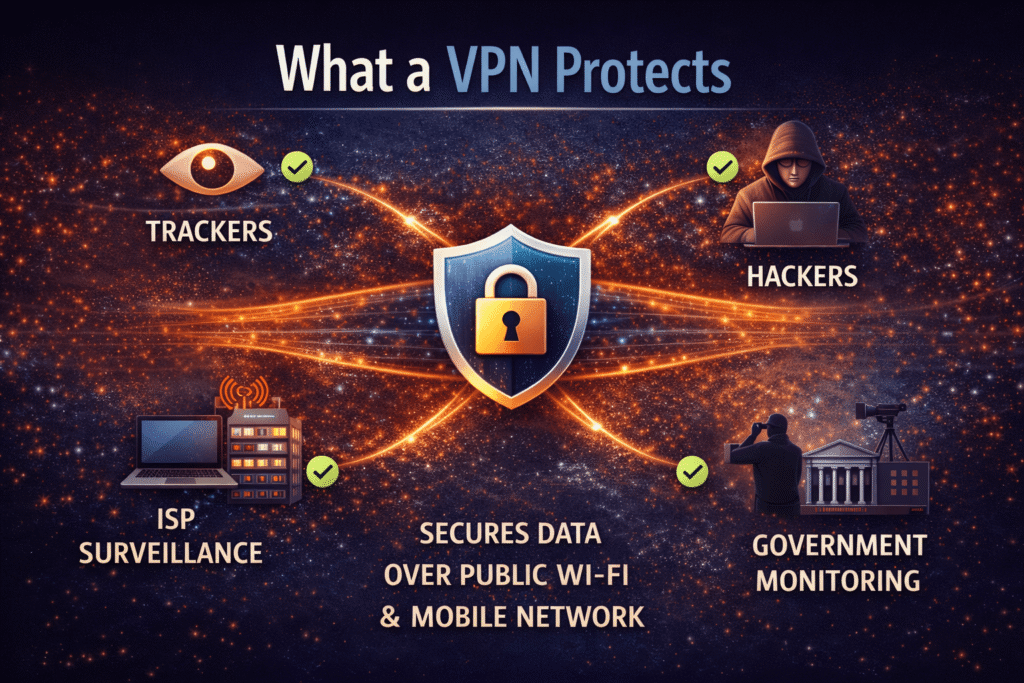
A VPN is engineered with a very specific purpose: securing your data while it is in transit across the internet. That distinction matters. It doesn’t sit on your device scanning files or blocking threats—it operates at the network level, protecting the pathway your data travels through.
When your connection is active, a VPN creates an encrypted tunnel that shields your data from external visibility. This makes it highly effective against several common risks that exist on open networks.
It prevents interception, meaning that even if someone attempts to capture your data packets—such as on public WiFi—they won’t be able to read them. It also reduces tracking, limiting the ability of websites, advertisers, and internet providers to build a behavioral profile based on your activity.
At a broader level, it protects against surveillance, making it significantly more difficult for third parties to monitor your browsing habits in real time. And by masking your IP address, it eliminates direct IP-based identification, breaking the link between your online actions and your physical location.
However, this protection has clear boundaries.
A VPN does not operate inside your device, which means it cannot defend against threats that originate from user interaction or compromised systems. If malicious software is downloaded, a VPN will not detect or remove it. If a phishing email tricks you into entering sensitive information, the VPN will not intervene. And if your device itself is already compromised, the VPN will simply encrypt and transmit that compromised data—without correcting the underlying issue.
This is where many misunderstandings occur. A VPN strengthens your privacy and secures your connection, but it does not replace a full cybersecurity strategy.
In practical terms, a VPN should be seen as one critical layer within a broader security stack—working alongside antivirus software, safe browsing practices, and user awareness.
Why VPN Usage Is Growing Rapidly
The rapid rise in VPN usage is not a coincidence—it’s the direct result of how the digital landscape has evolved over the past decade. As the internet becomes more integrated into everyday life, the risks, limitations, and dependencies tied to it have grown just as quickly.
One of the primary drivers is the increasing awareness of online privacy. Users are no longer unaware of how much data is being collected. From targeted advertising to large-scale data breaches, people are starting to understand that their online behavior is constantly monitored, analyzed, and stored. This shift in awareness naturally leads to action—and a VPN is one of the most accessible tools to regain a level of control.
At the same time, the global expansion of remote work has fundamentally changed how people access digital systems. Employees are no longer operating within secured office networks but are connecting from homes, cafés, and shared environments. This decentralization has made secure connections essential rather than optional, pushing both individuals and companies toward VPN adoption.
Another major factor is the steady increase in cyber threats. Attacks are becoming more sophisticated, more frequent, and more targeted. Whether it’s data interception, network spoofing, or unauthorized surveillance, the need to secure data during transmission has never been greater. A VPN directly addresses this vulnerability by encrypting traffic and reducing exposure.
In parallel, the internet itself has become more fragmented due to geo-restrictions and digital barriers. Content, services, and even information are often limited based on location. This has created a demand for tools that can bypass these restrictions, allowing users to access a more open and global version of the internet.
Underlying all of this is a broader shift toward digital independence. Users no longer want to be passive participants in systems that track, restrict, or monetize their behavior without transparency. They want control—over their data, their access, and their identity.
As a result, VPNs are no longer seen as niche tools for tech-savvy users. They are steadily becoming part of the core infrastructure of how individuals interact with the internet—a foundational layer that supports privacy, security, and unrestricted access in an increasingly complex digital world.
Strategic Perspective
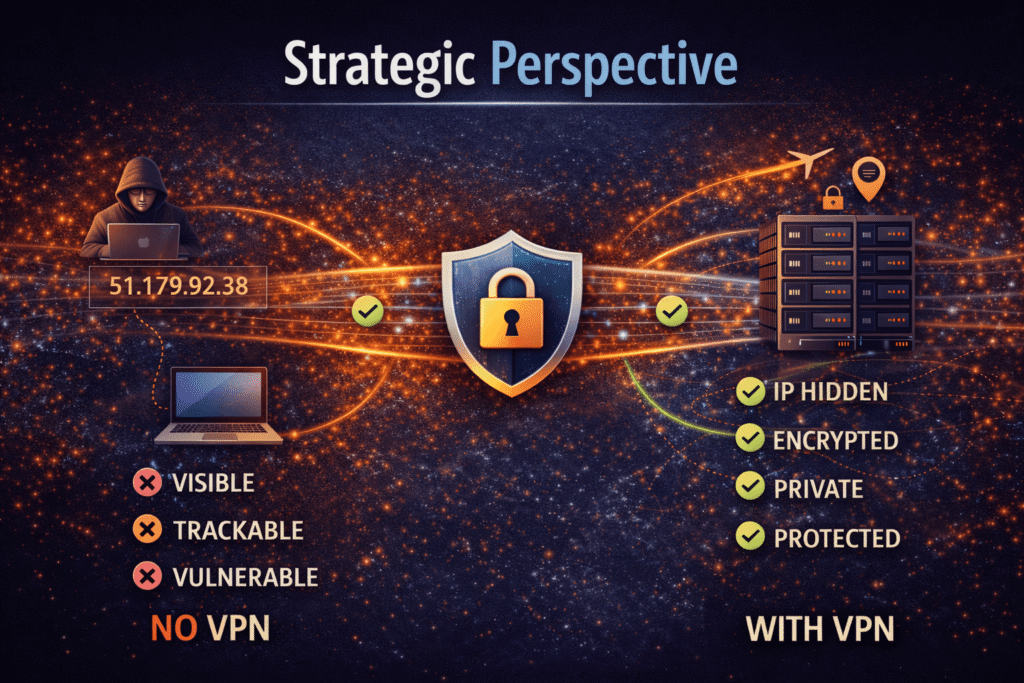
A VPN does more than encrypt your connection—it reshapes how you exist within the digital ecosystem. The internet, in its original design, prioritizes openness and accessibility, not discretion. Every request you make, every page you visit, and every interaction you have leaves behind identifiable traces. In that default state, visibility is the norm.
By introducing a VPN into that equation, you shift from passive exposure to active control.
Control over your identity means that your real IP address is no longer the reference point for your activity. Instead of being directly linked to your actions, your presence online becomes abstracted behind a secure endpoint. This alone disrupts a wide range of tracking mechanisms that rely on consistent identification.
Control over your data ensures that the information you send and receive is no longer openly readable as it travels across networks. Through encryption, your data is transformed into a protected stream, inaccessible to intermediaries who would otherwise monitor or collect it.
Control over your location allows you to decouple your physical presence from your digital footprint. What appears online is no longer tied to where you actually are, but to where you choose to connect from—introducing flexibility and removing imposed limitations.
Taken together, these elements form a strategic layer that sits between you and the internet itself. A VPN does not change the structure of the internet, but it changes how you interact with it. It introduces privacy and security into an environment that was never inherently built to provide either, allowing you to operate with a level of autonomy that would otherwise be absent.